
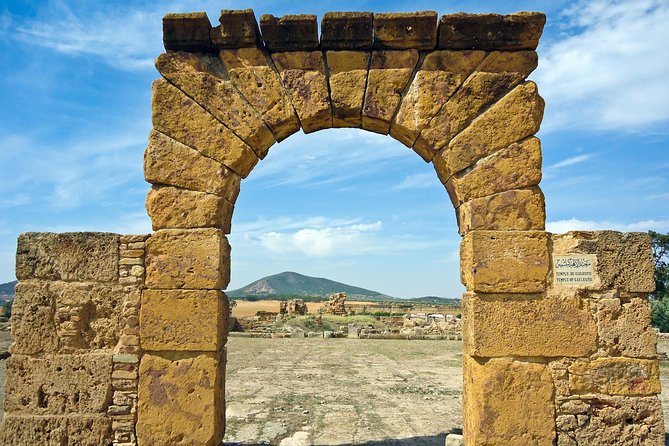
Reviewed · DOUGGA AND BULLA REGIA
Zaghouan, Thuburbo Majus and Dougga Private Self-Guided Excursion from Hammamet
Ancient waterworks set the story in motion. This private day from Hammamet links Zaghouan’s sacred spring, a Roman aqueduct, Thuburbo Majus, and Dougga in one long sweep through Tunisia’s past. I like the private vehicle, which keeps the day comfortable for a group of up to three, and I like the flexible pace, since you can spend more time at the ruins that catch your eye. The main drawback is simple: this is not a guided tour, so you need to bring your own curiosity or arrange a local guide separately.
You should also plan for a full day, not a quick outing. The drive, four stops, and large archaeological sites add up to about eight to ten hours. Lunch and site entrance fees are extra, though the driver can suggest a place to eat. One French-language review praised the visit as highly interesting and described the guide as competent and friendly, but the current tour details specify private transportation without a local guide, so confirm exactly what support you want before booking.
In This Review
- Key points at a glance
- Why this private Hammamet day trip works
- Zaghouan’s Water Temple and the start of the aqueduct story
- The 30-minute aqueduct stop near Zaghouan
- Three hours among the ruins of Thuburbo Majus
- Dougga, Tunisia’s grandest archaeological stop
- What the $279.58 price really buys
- Who should book this excursion
- Practical details before you go
- Should you book it?
- FAQ
- Where does the excursion begin?
- How long does the experience last?
- Is this a private tour?
- Is a local guide included?
- Is lunch included?
- Are entrance fees included?
- What is included in the price?
- Can I cancel for a full refund?
Key points at a glance
- Zaghouan’s Water Temple explains the whole route: You begin at the spring that fed the Roman aqueduct system serving cities including Carthage.
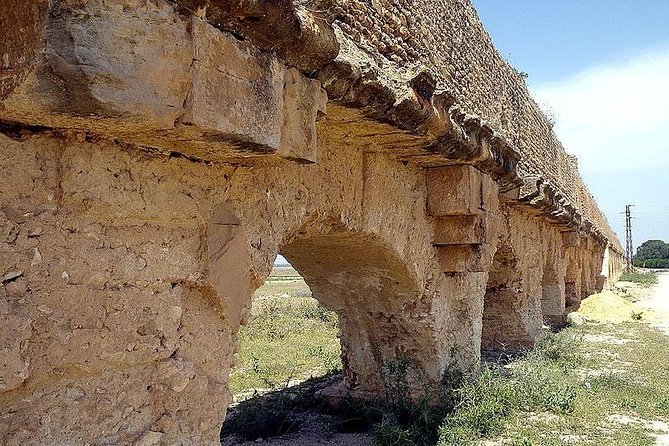
- A short aqueduct stop adds useful context: The 30-minute pause at L’aqueduc de Zaghouan helps you see how water moved from the mountain source toward Roman settlements.
- Thuburbo Majus rewards a slow three-hour visit: Its Capitol, forum, baths, temples, market square, and villas give you a broad look at Roman urban life.
- Dougga is the day’s main event: This UNESCO-listed, 65-hectare site contains some of North Africa’s best-preserved Roman monuments.
- The trip is private, not guided: You travel only with your group, but entrance to the sites, lunch, and a local guide are not included.
- The $279.58 group price favors small parties: For up to three people, the cost buys private transport, bottled water, parking, and a full day away from Hammamet.
Why this private Hammamet day trip works
The strength of this excursion is its clear historical thread. You are not simply checking off three old sites. You start where the water began, follow part of the Roman supply route, then visit two cities that depended on the same Roman engineering and civic system.
That order matters. At Zaghouan, you see the source. At the aqueduct, you see the delivery system. At Thuburbo Majus and Dougga, you see what Roman cities did with water, wealth, religion, public space, and government. Even without a guide, the route gives your day a useful shape.
I also like the private format for this particular outing. Thuburbo Majus and Dougga are large sites, and fixed group schedules can leave you hurrying past the very details that make ancient places memorable. With only your own group in the vehicle, you can ask to linger at a temple, shorten a stop, or use the driver’s advice when it is time for lunch.
The catch is that flexibility does not equal interpretation. The driver handles transportation, but a local guide in English, French, Italian, German, Spanish, or Russian is listed as an extra rather than part of the package. If you want the meaning of every monument explained as you walk, budget for that separately.
More Roman sites at Dougga and Bulla Regia:
- Private Day Trip to Testour, Dougga and Bulla Regia from Hammamet
★ 5.0 · 21 reviews - Private Guided Tour of Zaghouan, Thuburbo Majus and Dougga from Hammamet
★ 5.0 · 1 review - Private Excursion to Testour, Dougga and Bulla Regia from Tunis.
★ 5.0 · 100 reviews
Zaghouan’s Water Temple and the start of the aqueduct story
Your first stop is the Water Temple in Zaghouan, where the spring supplied the Roman aqueduct system. The visit is scheduled for about an hour, and admission is free.
This is an excellent opening because it gives purpose to the rest of the day. Water was not a minor convenience for Roman cities. It supported public baths, fountains, households, and civic life. From this source, water was carried toward several Roman cities, including Carthage.
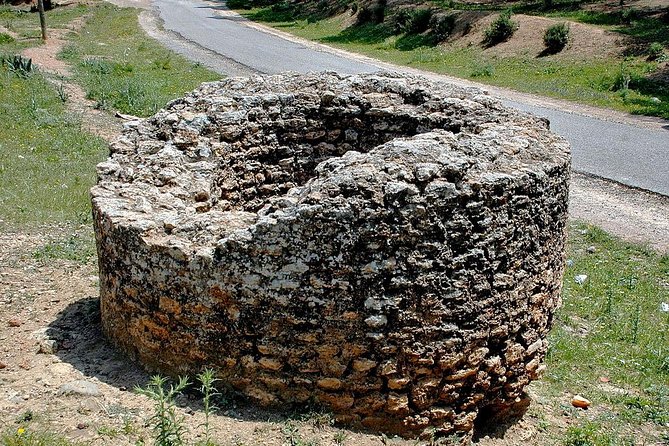
The site also gives you a moment to slow down before the larger ruins. You can focus on the setting and the idea behind the engineering rather than trying to absorb a huge city all at once. I would pay attention to the relationship between the spring and the long-distance aqueduct. The ancient builders had to collect, control, and move water across difficult ground, and this stop lets you see the first stage of that system.
Because no admission fee is listed here, the Water Temple is a low-cost stop with high value. Still, do not expect a full interpretive visit unless you arrange a guide. The supplied water bottle, one per passenger, is useful on a long day, but you should treat it as a small convenience rather than your only drink for eight to ten hours.
The 30-minute aqueduct stop near Zaghouan
The next stop, L’aqueduc de Zaghouan, takes about 30 minutes. It is a brief roadside-style pause in the wider journey toward Thuburbo Majus, but it fills in the practical part of the story.
Here you see the ancient Roman aqueduct that carried water from the Water Temple toward cities including Thuburbo Majus and Carthage. The first stop shows the source. This one shows the infrastructure that made the source useful.
Thirty minutes is enough for a look and some photographs, but not enough for a long study. That is not a serious flaw, because the aqueduct functions as a connecting stop rather than the main attraction. Its value comes from linking the first and third stops in your mind.
If you enjoy Roman engineering, this is where you may wish you had more explanation. Ask the driver about the planned timing and use the stop to get oriented before the larger archaeological sites. The private setup gives you a little more control, but the excursion still has a long route to cover.
Three hours among the ruins of Thuburbo Majus
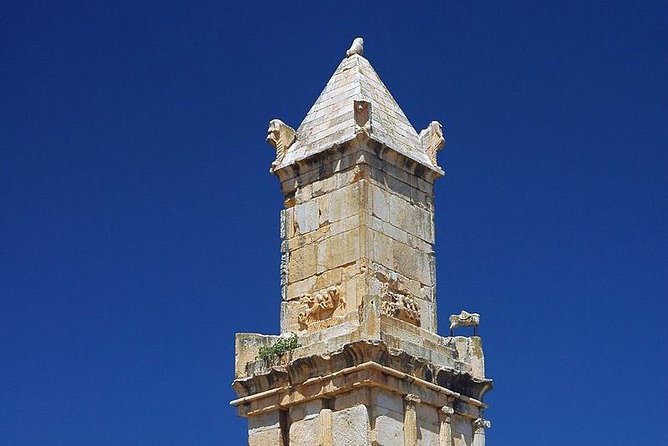
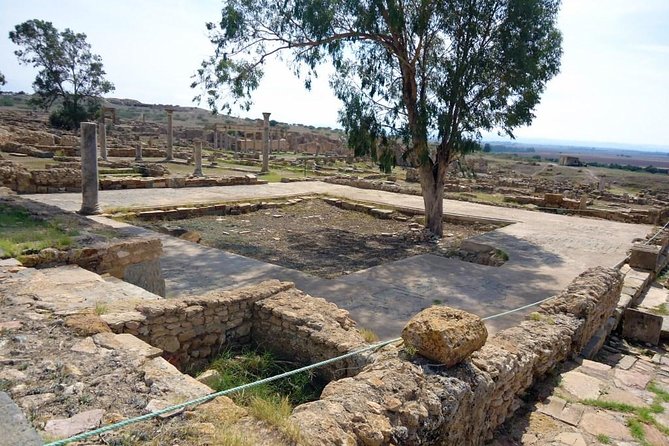
Thuburbo Majus receives about three hours, which is a sensible amount of time for a city of this scale. Admission is not included, with the stated archaeological-site fee listed as 3 € per person.
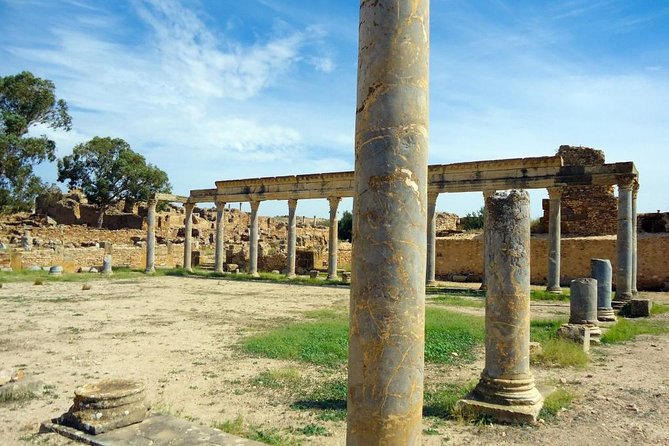
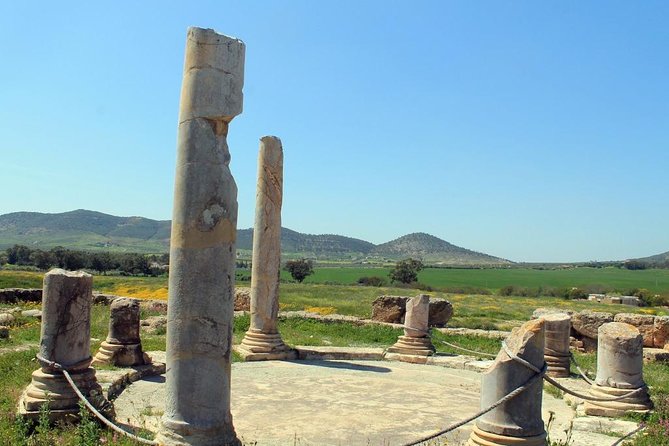
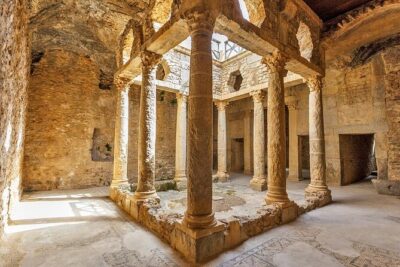
This was not a single monument. It was a full Roman city, and the planned visit takes in its Capitol, forum, Villa of Neptune, Palestra of the Petronii, Temple of Mercury, Byzantine church, summer baths, winter baths, and market square.
That list tells you how varied the stop can be. The Capitol and forum point to public government and ceremony. The villas suggest private wealth and decorative taste. The palestra and baths show the social side of Roman life, where exercise, bathing, and conversation mattered as much as formal business.
The two sets of baths are especially useful for understanding how daily life depended on water. After seeing the source and aqueduct earlier in the day, you can look at the baths with a better sense of the system behind them. The ruins become more than scattered stones. They show where the water ended up and how people used it.
The Byzantine church adds another layer. Thuburbo Majus was not frozen in one Roman moment. Later communities adapted the city and reused its spaces. That mix makes the site more rewarding for anyone who wants to see change over time rather than only classic Roman remains.
Three hours sounds generous, but a large open-air archaeological site can absorb it quickly. Without a guide, I would suggest choosing a few major areas to study rather than trying to give every ruin equal attention. If you move too fast, the forum, temples, baths, and villas can blur together.
The driver can recommend a lunch stop, but food is not included. Since the day is long, ask about lunch timing before you reach Thuburbo Majus. You will not want to leave a major site hungry, yet you also do not want to spend your best viewing time searching for a restaurant.
More self-guided tours in Hammamet:
- Kairouan, El Djem, Monastir Self-Guided Excursion from Hammamet
★ 4.5 · 5 reviews - Tunis, Carthage and Sidi Bou Said Self-Guided Excursion from Hammamet
★ 4.5 · 4 reviews - Cap-Bon Self-Guided Excursion from Hammamet
★ 4.5 · 3 reviews - Self guided bike tour of Carthage archeological site
★ 4.5 · 10 reviews
Dougga, Tunisia’s grandest archaeological stop
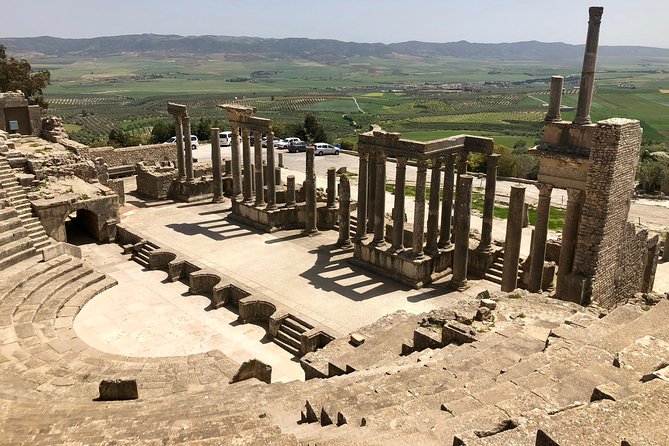
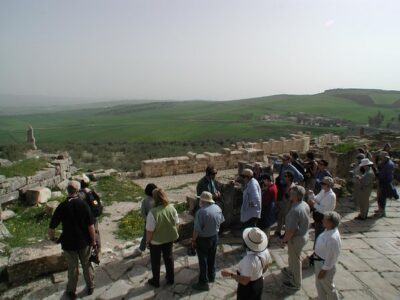
Dougga is scheduled for three hours and is the high point of the outing for most people. The site covers about 65 hectares and is listed as a UNESCO World Heritage site. The entrance fee is not included, and the stated archaeological admission is 3 € per person.
The scale is the first thing to understand. Dougga is not a compact ruin that you can cross in twenty minutes. You walk among a broad collection of monuments, including the Capitol, Wind Rose, Libyco-Punic Mausoleum, dolmens, market, Villa of the Trifolium, Temple of Mercury, Temple of Minerva, and Temple of Saturn.
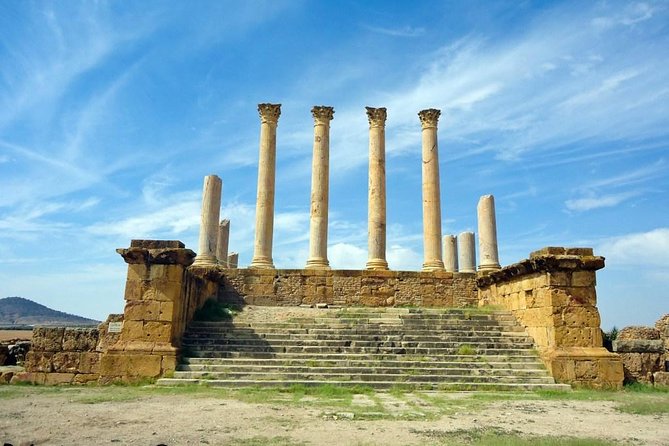
The Capitol is one of the key sights. Public buildings like this help you read Dougga as a functioning city, not just a collection of temples. The temples show the religious side of civic life, while the market and villas give you a sense of commerce and domestic space.
The Libyco-Punic Mausoleum is important because it points to cultural layers that reach beyond the Roman period. The dolmens add another early element. These monuments help you see that Dougga’s story did not begin with Roman rule, and that the site reflects more than one period of North African history.
The Wind Rose is another distinctive feature. It offers a reminder that ancient cities included practical public spaces as well as grand religious and political buildings. At Dougga, you can spend part of your time looking closely at individual monuments and part simply trying to understand the city’s layout.
Three hours is enough for a strong first visit, but it will not let you examine every corner of a 65-hectare site. Wear comfortable shoes and expect a moderate level of physical activity. The tour specifically calls for moderate physical fitness, so this is not the best choice if walking through a large ruin is difficult for you.
The lack of a local guide matters most at Dougga. The monuments are impressive on their own, but names and ruins do not always explain themselves. A guide could help you connect the Libyco-Punic, Roman, and later periods. If you prefer exploring at your own speed and reading the site through its remains, the private format will feel liberating. If you want a structured history lesson, arrange guiding help in advance.
What the $279.58 price really buys
The listed price is $279.58 per group of up to three people. That means the value depends heavily on how many people share the vehicle. For three, it works out to roughly $93 per person. For two, it is about $140 per person. A solo participant pays the full group rate, so the format makes the most financial sense for a small party.
The price includes an air-conditioned vehicle, private transportation, parking fees, gratuities, and one bottle of water per passenger. Those inclusions matter on a long road day. Air conditioning is especially welcome when you are moving between several outdoor sites, and parking fees and gratuities being covered keep the basic cost clearer.
You still need to pay for lunch, personal expenses, and archaeological admission. At 3 € per person, entrance fees are modest, but they should not catch you by surprise. A local guide is also not included, even though guiding in several languages is available as an extra.
For a group of three that wants a private vehicle and a full day covering places that would be awkward to combine independently, the price is reasonable. For one person, it is harder to call it a bargain. The best value comes from sharing the ride and making good use of the flexible schedule.
Who should book this excursion
I would recommend this trip to a small group that wants to cover several important ancient sites in one day without joining strangers. It suits couples, families, or friends who value their own vehicle and do not mind exploring without a guide.
It is also a good match for people who already know a little about Roman history. You will get more from the Capitol, baths, temples, villas, and aqueduct if you recognize what you are looking at. If ancient sites are new to you, you can still enjoy the scale and setting, but a guide would add real value.
The pace suits active sightseers. You visit four stops, spend about three hours at each major city, and remain on the road for much of the day. This is not a lazy Hammamet outing with a short sightseeing break.
I would think twice if you dislike long days, need a fully narrated tour, or have difficulty walking across uneven archaeological sites. The moderate fitness requirement is worth taking seriously. You should also confirm the exact pickup arrangement from Hammamet and whether you want to add a licensed local guide.
Practical details before you go
Pickup is offered in Hammamet, and confirmation is provided at booking. The experience uses a mobile ticket, so keep your booking details available on your phone.
The tour lasts approximately eight to ten hours. That range leaves room for road conditions, time spent at the sites, and a lunch break. Since lunch is not included, ask the driver for a recommendation and decide early when you want to eat.
Only your group participates, with a maximum of three people. Service animals are allowed. Free cancellation is available if you cancel at least 24 hours before the start time. Changes or cancellations made within 24 hours are not accepted for a refund, and the cutoff follows local time.
Should you book it?
Book this excursion if you want an ambitious private day built around Roman engineering and archaeology. The Water Temple, aqueduct, Thuburbo Majus, and Dougga form a logical route, and the private vehicle gives a small group welcome control over the day.
The strongest reason to go is Dougga, supported by the useful water story that begins in Zaghouan. The main limitation is the lack of a local guide in the basic price. For the best experience, share the cost with two other people, arrange guiding if history is your main interest, and set aside money for lunch and entrance fees.
FAQ
Where does the excursion begin?
The excursion begins with pickup in Hammamet.
How long does the experience last?
The experience lasts approximately eight to ten hours.
Is this a private tour?
Yes. Only your group participates, with a maximum of three people.
Is a local guide included?
No. A local guide is not included in the basic experience. Guiding is listed as an extra in English, French, Italian, German, Spanish, and Russian.
Is lunch included?
No. Lunch is not included, but the driver can recommend places to eat.
Are entrance fees included?
No. Entrance fees to the archaeological sites are not included. The stated fee is 3 € per person.
What is included in the price?
The price includes an air-conditioned vehicle, private transportation, bottled water with one bottle per passenger, gratuities, and parking fees.
Can I cancel for a full refund?
Yes, if you cancel at least 24 hours before the experience start time. Cancellations or changes made less than 24 hours before the start time are not accepted for a refund.
Just added in Hammamet
- Transfer from Airport Tunis Carthage To Hammamet★ 5.0 · 2 reviews
- From Hammamet: Sahara Desert Overnight Camping★ 4.5 · 2 reviews
- Private Transfer from Tunis Carthage Airport to Hammamet★ 5.0 · 2 reviews
- Private Guided Tour of Zaghouan, Thuburbo Majus and Dougga from Hammamet★ 5.0 · 1 review
- Executive: Transfer Tunis Airport to Hammamet by Mercedes E Class★ 5.0 · 4 reviews
- Private Excursion of Friguia Park and Medina of Hammamet★ 4.5 · 4 reviews
- Day Trip to Cap Bon★ 5.0 · 2 reviews
- Tunis, Carthage and Sidi Bou Said Self-Guided Excursion from Hammamet★ 4.5 · 4 reviews
Dougga and Bulla Regia, compared.
Private Excursion to Testour, Dougga and Bulla Regia from Tunis.
Read our review →
Full Day Dougga & Bulla Regia Via Testour Private tour with Lunch
Read our review →
Private Day Trip to Testour, Dougga and Bulla Regia from Hammamet
Read our review →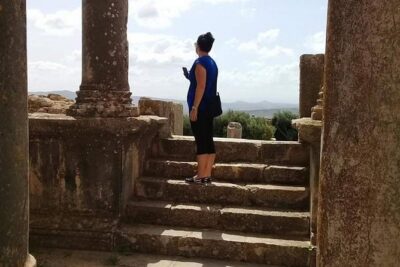
Private Guided Tour of Dougga and Testour Mosque
Read our review →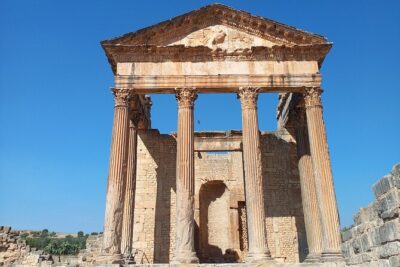
Bulla Regia and Beni Mtir Cascade Daytrip from Tunis
Read our review →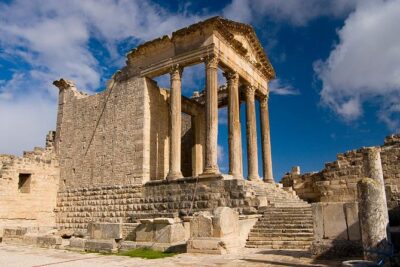
Browse the lists this tour appears in