
Reviewed · DOUGGA AND BULLA REGIA
Private Guided Tour of Dougga and Testour Mosque
Ancient Tunisia feels wonderfully open here. This private day trip pairs the superb Roman ruins of Dougga with the lesser-known archaeological site of Aïn Tounga and the unusual Great Mosque of Testour, giving you three very different views of Tunisia’s past in roughly six to seven hours.
I especially like the door-to-door pickup from Tunis or Hammamet and the chance to explore Dougga without being tied to a large group. The unusual counterclockwise clock on Testour’s minaret is another fine touch. The main consideration is the long day and the amount of walking over uneven archaeological ground, especially if you want time to explore Dougga properly.
In This Review
- Key points to know before booking
- Why Dougga deserves the long drive
- Aïn Tounga rewards curiosity
- The Great Mosque of Testour and its upside-down clock
- What the private format changes
- Is $127.81 a fair price?
- Timing, walking, and practical comfort
- Who will enjoy this outing most?
- How it compares with Tunisia’s better-known ruins
- Should you book the Dougga and Testour tour?
- FAQ
- Where does the tour begin?
- How long does the tour last?
- Is this a private tour?
- What sites are included?
- Are admission tickets included?
- What is unusual about Testour’s mosque?
- Can service animals join the tour?
- Can I cancel for a full refund?
Key points to know before booking
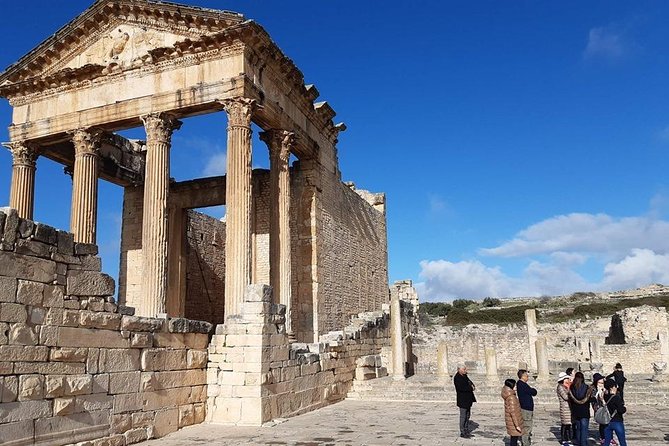
- Dougga preserves a whole Roman town: You see streets, houses, temples, tunnels, and a theater rather than one isolated monument.
- Aïn Tounga adds an off-the-beaten-path stop: The site is less developed for visits, which can make it feel quieter but also less polished.
- Testour’s mosque has a rare clock: Its hands move counterclockwise, and the numbers are placed upside down.
- Private transport saves time: Pickup and drop-off are offered from Tunis or Hammamet, with admission included.
- The tour usually takes six to seven hours: That makes it a practical full-day outing, but not a quick city excursion.
- Guide quality matters: Ghassen received especially warm praise for being friendly and helpful.
Why Dougga deserves the long drive
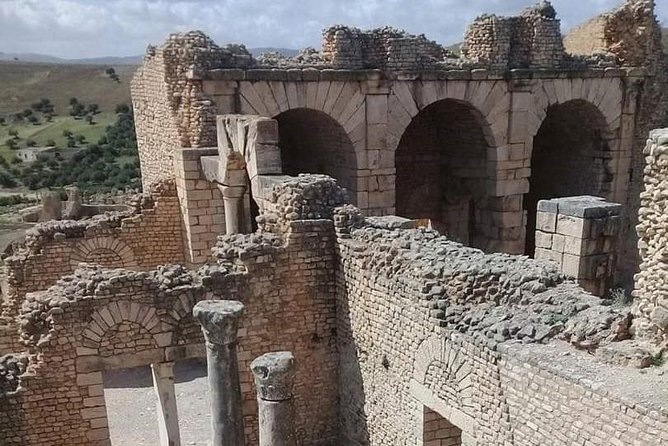
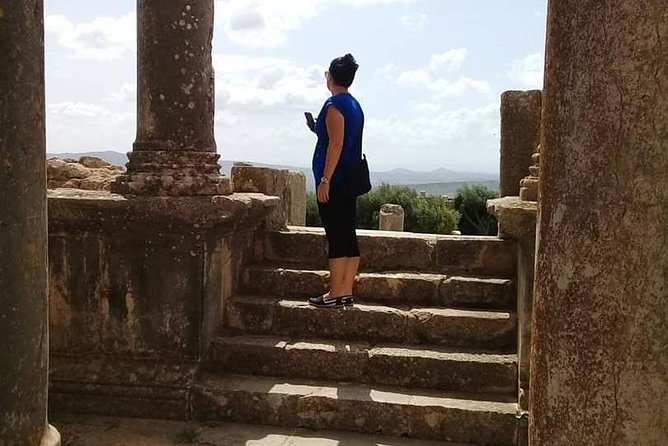
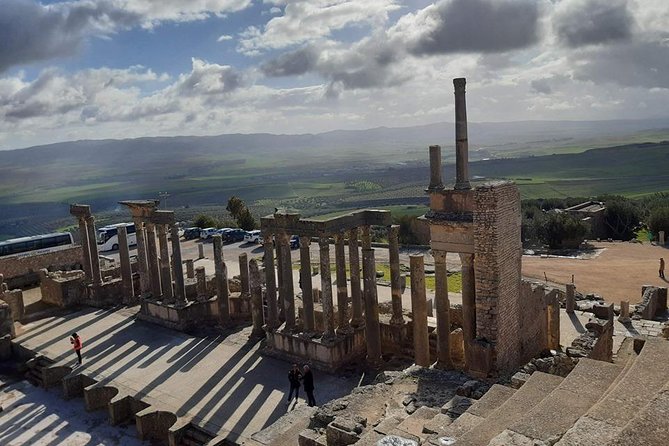
Dougga is the main reason to book this experience. The ruins spread across a hilltop above valleys and olive plantations, so the road there is part of the pleasure. The setting feels rural and open, a sharp contrast to ancient monuments surrounded by modern streets.
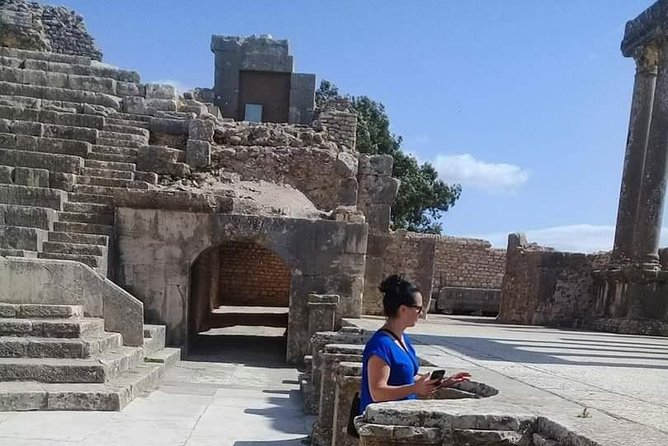
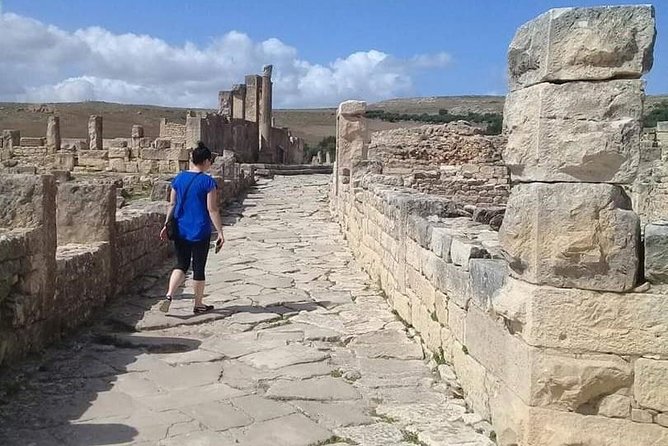
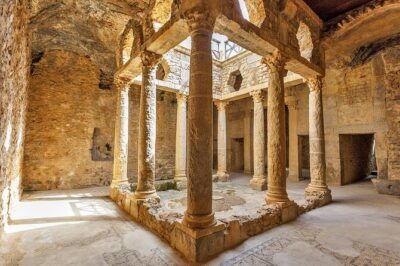
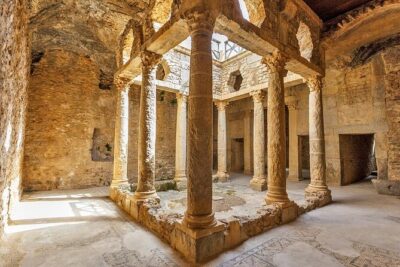
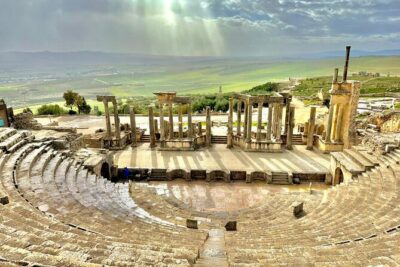
I like Dougga because you are not simply looking at one famous temple from behind a barrier. The remains show the shape of an entire town. Roman roads run between houses and public buildings. You can climb into structures, pass through tunnels, and examine temples and other ruins at your own pace.
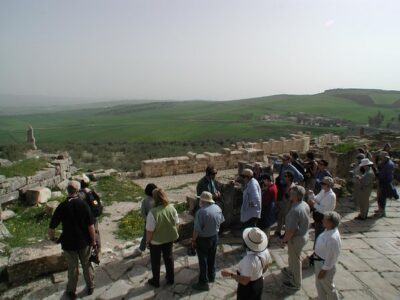
That scale changes the visit. Instead of checking off a monument in fifteen minutes, you begin to understand how the town worked. The hilltop position also gives you wide views across the surrounding countryside, with olive groves and cultivated valleys below.
The site reaches beyond the Roman period. You can also find evidence of earlier Punic use, including an old temple with a cleansing bath. That makes Dougga more than a Roman sightseeing stop. It gives you a compact lesson in how different cultures used the same place over time.
Plan on about two hours at Dougga. That is enough for a useful visit, though you may wish the schedule allowed longer if you enjoy ancient architecture or photography. The site is extensive, and walking in and out of ruins takes time. You should expect uneven surfaces and uphill movement because the town sits on a slope.
More Roman sites at Dougga and Bulla Regia:
- Private Excursion to Testour, Dougga and Bulla Regia from Tunis.
★ 5.0 · 100 reviews - Full Day Dougga & Bulla Regia Via Testour Private tour with Lunch
★ 5.0 · 29 reviews - Dougga and Bulla Regia Guided Tour From Tunis
★ 4.5 · 11 reviews
Aïn Tounga rewards curiosity
Aïn Tounga appears on the road between Testour and Dougga, near the edge of the route. The first clue is a large square tower in ruins. It may look like an isolated remnant, but it marks the entrance to a much larger archaeological site stretching along a hillside among fields and olive groves.
This stop gives the day a different mood. Dougga is the major attraction, with a broad collection of visible buildings and roads. Aïn Tounga feels less developed for sightseeing, so you may encounter fewer visitor facilities and less obvious guidance on site.
That is both its appeal and its limitation. I like the chance to see a place that has not been arranged into a polished tourist circuit. You can get a stronger sense of Tunisia’s many archaeological remains, scattered well beyond the famous sites near Tunis.
You should keep your expectations realistic. The supplied details do not give a fixed visit length, and the site is described as not yet fully highlighted or developed for visits. That means the experience may depend more heavily on your guide and on conditions that day. If you prefer clear paths, signs, and a predictable museum-style visit, Aïn Tounga may feel rough around the edges.
If you enjoy ruins, rural scenery, and places that require a little more imagination, this is an excellent addition. The hillside setting and olive groves also break up the Roman focus of Dougga with a quieter stop in the countryside.
The Great Mosque of Testour and its upside-down clock
Testour provides the cultural change of pace that keeps the day from becoming a sequence of Roman ruins. The Great Mosque is known for Andalusian influence, linking the town to communities who arrived from Spain around three centuries ago.
The minaret contains the most memorable detail: a clock whose hands move in the opposite direction from a normal watch. The numbers are also placed upside down. After a long period out of service, the clock began working again in December 2014.
You only spend about thirty minutes here, and admission is free. That short stop makes sense because the clock and minaret are the focus. It is not presented as a long interior visit or an extended architectural tour.
I find this stop valuable because it broadens the day. Dougga introduces Punic and Roman Tunisia, while Testour points to a later Andalusian chapter. You are not seeing the same type of monument three times. Instead, the route connects different periods and traditions across northern Tunisia.
The mosque visit may feel brief if you want a detailed examination of the town. Still, as part of a six to seven hour outing, thirty minutes gives you a clear look at the minaret without pushing the day too late.
What the private format changes
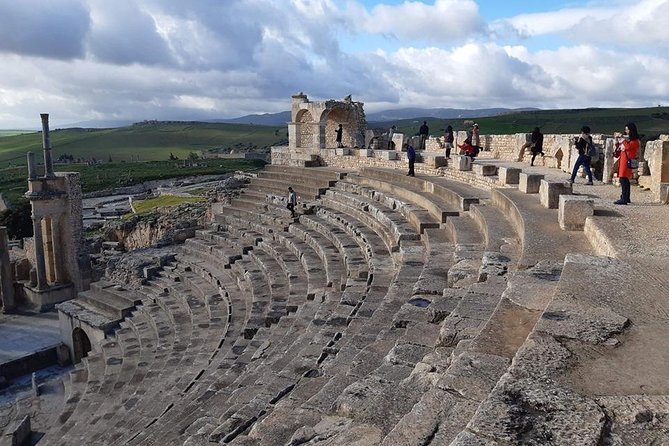
A private tour means only your group participates. That matters most at Dougga, where the ruins cover a large area and you may want to pause at a temple, house, tunnel, or view without waiting for strangers to catch up.
Private touring also lets the guide adjust the pace within the limits of the day. If you are interested in ancient roads, military remains, religious buildings, or the rural setting, you can focus your questions in that direction. The experience is more personal than a fixed group circuit.
Pickup and drop-off are offered from Tunis or Hammamet. For you, the biggest practical benefit is avoiding the work of arranging separate transport to a hilltop archaeological site, then finding your way onward to Testour and Aïn Tounga.
The vehicle transfers are described as comfortable, and the service is door to door. Admission tickets are included for the archaeological visits. You should still allow for a substantial amount of time in the vehicle because Dougga is outside Tunis and the itinerary covers several places.
The tour is often booked around five days ahead. That suggests you should not leave it until the last moment if your dates are fixed, especially because private capacity is naturally limited. Confirmation is received at booking, and a mobile ticket is available.
More things to do in Tunis:
- Private Tour to Kairouan, El Jem & Monastir from Tunis_hammamet
★ 5.0 · 301 reviews - Private tour: Medina,Carthage ,Sidi Bou Said, Bardo Museum+lunch
★ 5.0 · 230 reviews - Carthage, Bardo Museum, Sidi Bou Said and Medina Private Day Tour
★ 4.5 · 153 reviews - Guided Bike Tour of Carthage Archeological Site in Tunisia
★ 5.0 · 88 reviews
Is $127.81 a fair price?
At $127.81 per person, this is not the cheapest way to see one Tunisian monument. The value becomes clearer when you count what is included: private participation, pickup and drop-off from Tunis or Hammamet, comfortable vehicle transport, and admission tickets.
You are also covering three distinct stops in one day. A self-organized visit would require transport planning, route coordination, and enough confidence to connect Dougga with Aïn Tounga and Testour. The private format removes much of that friction.
The price makes the most sense for couples, families, or small groups who value time and convenience. Group discounts may improve the cost for larger parties. If you are traveling alone and watching every dinar, a shared excursion could be cheaper, but this specific experience is built around privacy rather than the lowest fare.
The guide can also affect the value. Ghassen is singled out for being friendly and offering good advice, which is exactly what you want at a spread-out site such as Dougga. A strong guide helps you understand what you are looking at instead of leaving you with a pile of impressive stones and no story.
Timing, walking, and practical comfort
The full outing lasts approximately six to seven hours. That is long enough to make the rural drive worthwhile while still fitting into a single day from Tunis or Hammamet.
Dougga is the physically demanding part. You will need to walk around a large hilltop site and move over uneven ancient surfaces. The information provided says most people can participate, but it does not promise step-free access or a fully smooth route.
You should choose practical clothing and footwear for walking. The tour requires good weather, and poor conditions can lead to a different date or a full refund. That weather clause matters because exposed hilltop ruins are less enjoyable when conditions are poor.
Service animals are allowed, and the pickup points are near public transportation. Those details help, but the private vehicle remains the main way to reach the archaeological sites. The tour is not designed as a public-transit outing.
Because the schedule includes rural sites, do not treat this as a flexible hop-on, hop-off day. Keep the morning and afternoon open. The tour description does not specify meal stops, so you should clarify food arrangements before departure rather than count on a long restaurant break.
Who will enjoy this outing most?
I would recommend this experience to anyone who wants ancient Tunisia in a broad setting rather than a quick look at Carthage. Dougga is especially suited to people who like walking through ruins and seeing how a town fits together.
It also works well for visitors staying in Tunis or Hammamet who do not want to rent a car. The pickup service and private vehicle make the day simpler, while the guide adds context to places that may be difficult to interpret alone.
Families with older children may enjoy the freedom to move through houses, tunnels, temples, and the theater. Younger children could find the walking and driving tiring, though the private format lets your group control pauses better than a large tour.
History fans will appreciate the range of periods. Dougga brings Punic and Roman remains, Aïn Tounga adds another archaeological setting, and Testour introduces Andalusian influence. You get variety without having to plan several separate day trips.
This may not suit you if you want a relaxed food-and-village outing, a highly polished museum experience, or a short excursion with little walking. Aïn Tounga in particular may feel too undeveloped for anyone who prefers formal visitor facilities.
How it compares with Tunisia’s better-known ruins
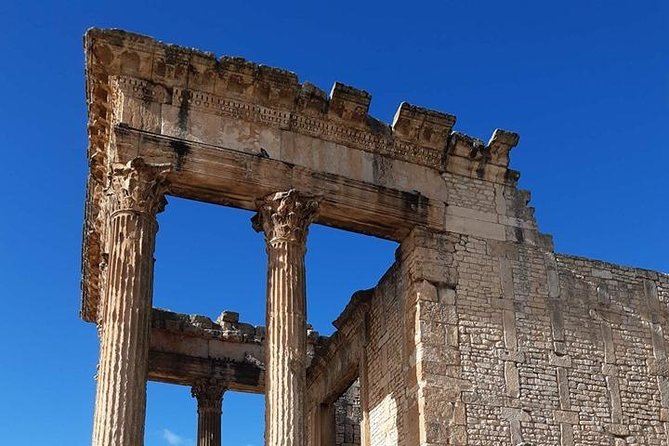
Dougga is presented as more complete than sites where one or two monuments remain surrounded by modern development. That comparison helps explain its appeal. You are looking across an ancient town, not just standing in front of a single surviving building.
The lack of barriers and large crowds, as described in the tour material, also gives the visit a more open feel. You can take your time moving through the remains rather than viewing everything from one marked path.
That freedom comes with responsibility. Uneven ruins require care, and you should not assume every structure is easy to enter. Follow your guide’s advice, especially around tunnels, slopes, and damaged buildings.
The combination with Testour keeps the day from becoming too narrowly Roman. You see how Tunisia’s past includes Phoenician, Roman, and Andalusian chapters, all within one manageable excursion.
Should you book the Dougga and Testour tour?
Book it if you want a private, well-organized day centered on Tunisia’s archaeological heritage, and if you value transport more than finding the absolute lowest price. Dougga is the star, but Aïn Tounga and Testour give the route more range and make the long outing feel worthwhile.
I would be more cautious if you dislike uneven walking, prefer a slow day, or need a fully developed visitor site at every stop. The $127.81 price is easiest to justify for a small group sharing the private vehicle, particularly when you include the pickup service and admissions.
The strongest reason to choose this tour is the combination of access and variety. You get the remarkable remains of Dougga, a quieter archaeological stop at Aïn Tounga, and Testour’s wonderfully odd counterclockwise clock, all without arranging the transport yourself.
FAQ
Where does the tour begin?
Pickup and drop-off are offered from Tunis or Hammamet.
How long does the tour last?
The experience lasts approximately six to seven hours.
Is this a private tour?
Yes. Only your group participates.
What sites are included?
The route includes Dougga, the archaeological site of Aïn Tounga, and the Great Mosque of Testour.
Are admission tickets included?
Admission tickets are included for the archaeological visits. Entry to the Great Mosque of Testour is free.
What is unusual about Testour’s mosque?
The minaret has a clock whose hands move counterclockwise, with numbers placed upside down. The clock returned to service in December 2014 after a long period out of use.
Can service animals join the tour?
Yes, service animals are allowed.
Can I cancel for a full refund?
Yes, you can cancel up to 24 hours before the experience begins for a full refund. Cancellations or changes made less than 24 hours before the start time are not accepted for a refund. The experience may be rescheduled or fully refunded if poor weather causes cancellation.
Just added in Tunis
- Private Arrival Transfer: Tunis Airport to Tunis Hotel★ 4.5 · 5 reviews
- Cap Bon Guided Day Tour from Tunis★ 5.0 · 2 reviews
- Unveiling the Beauty of Sidi Bou Said and Carthage Private Tour★ 5.0 · 2 reviews
- Dougga Guided Day Tour from Tunis★ 5.0 · 5 reviews
- Tunis Carthage Private Arrival Airport Transfer to Tunis★ 5.0 · 4 reviews
- Tunis Group Tour: Carthage, Sidi Bou Said, Bardo museum & Medina★ 5.0 · 5 reviews
- Bardo Museum , Oudhna and the roman aqueduct★ 5.0 · 4 reviews
- Bardo Museum- The ruins of Carthage- Village of Sidi Bou Said★ 5.0 · 4 reviews
Dougga and Bulla Regia, compared.
Private Excursion to Testour, Dougga and Bulla Regia from Tunis.
Read our review →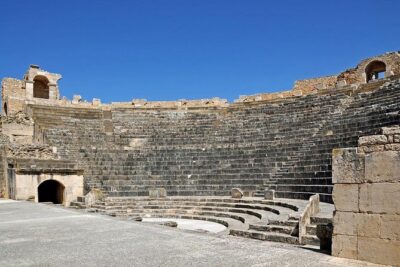
Full Day Dougga & Bulla Regia Via Testour Private tour with Lunch
Read our review →
Private Day Trip to Testour, Dougga and Bulla Regia from Hammamet
Read our review →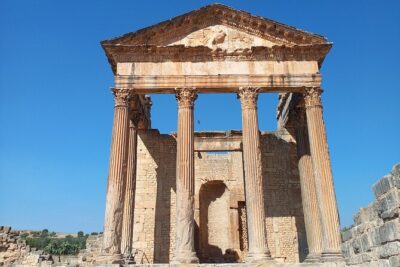
Bulla Regia and Beni Mtir Cascade Daytrip from Tunis
Read our review →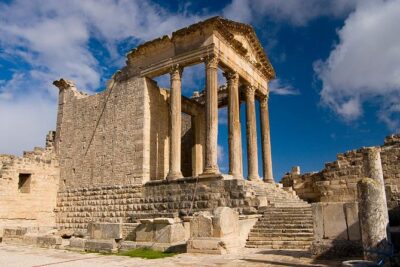
DAY TRIP TO Dougga & Bulla Regia , DEPARTURE FROM Tunis
Read our review →Browse the lists this tour appears in