
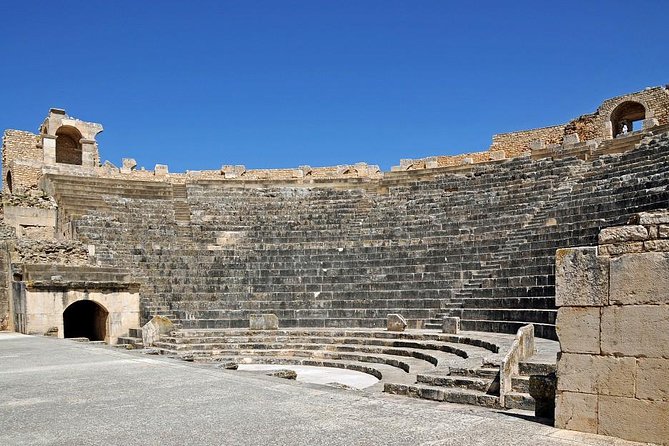
Reviewed · DOUGGA AND BULLA REGIA
Full Day Dougga & Bulla Regia Via Testour Private tour with Lunch
Ancient Tunisia rewards a long day west. This private excursion links Dougga and Bulla Regia, two of the country’s finest ancient sites, with hotel pickup, private air-conditioned transport, guiding, and lunch. I like the easy door-to-door setup, and I like that Bulla Regia lets you enter Roman homes built partly below ground. The tradeoff is the long road day, with roughly eight hours devoted to driving and sightseeing.
The guiding is a major part of the value. Visitors have praised guides including Mamdouh, Mahjoub, Mohammed, and Nejib for explaining history clearly without rushing, while drivers such as Idriss have earned praise for their care and helpful attitude. Lunch also gets unusually strong marks for a tour meal, including a well-handled vegetarian option.
One detail needs checking before you pay: the Dougga stop is shown as three minutes, which cannot represent a meaningful visit to such a large archaeological site. The overall timing is described as about eight hours, and one schedule ran from 7 a.m. to about 3 p.m., but ask the operator how much time you will actually spend at each site.
In This Review
- Key points at a glance
- Why Dougga and Bulla Regia work so well together
- The early road from Tunis to Tunisia’s northwestern ruins
- Dougga: Roman grandeur with Numidian roots
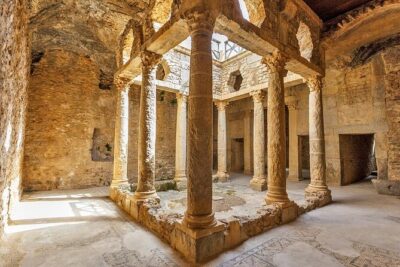
- Bulla Regia and the Roman homes below street level
- Testour offers a brief change of scene
- Lunch is more than a box between ruins
- Guides, drivers, and the private-tour advantage
- Is $115 good value for this day?
- Who should book this excursion?
- Booking details worth checking first
- Should you book Dougga and Bulla Regia?
- FAQ
- How long does the tour last?
- Where is hotel pickup available?
- Are Dougga and Bulla Regia included?
- How much time is spent at Bulla Regia?
- How long is the Testour stop?
- Is lunch included?
- Is a vegetarian meal available?
- Is the tour private?
- Can I cancel for a full refund?
Key points at a glance
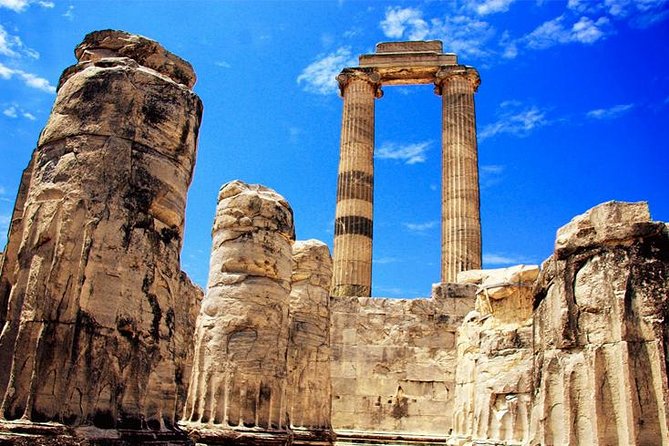
- Dougga on a hilltop: Walk among Roman and Numidian remains set above the countryside.
- Bulla Regia’s underground villas: See an unusual Roman housing style with rooms below street level.
- Private transport from Tunis or Hammamet: Avoid arranging several connections across northern Tunisia.
- Testour from the road: Catch a brief look at Andalusian-style buildings and the Great Mosque.
- Lunch with dietary flexibility: Vegetarian meals can be arranged when requested in advance.
- Strong guide and driver record: The experience has a 4.9 rating from 29 reviews, with 100 percent recommending it.
Why Dougga and Bulla Regia work so well together
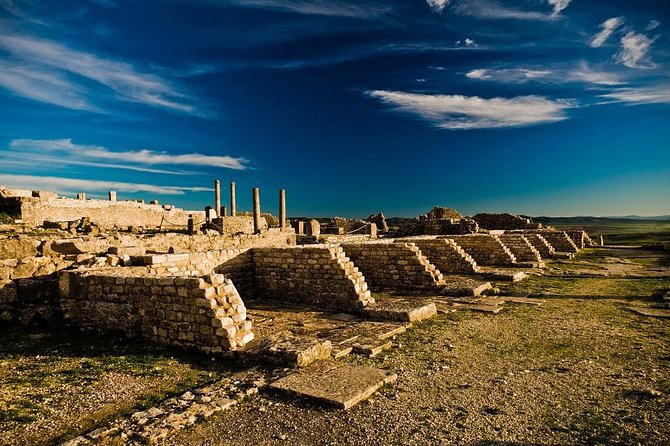
This is not simply two versions of the same ruin. Dougga gives you a grand open-air city on high ground, while Bulla Regia is more intimate and architectural, with houses designed partly underground.
That contrast makes the day satisfying. At Dougga, you get the broad sweep of a major ancient settlement: columns, public buildings, roads, and views across the hills. At Bulla Regia, you spend more time thinking about private life, room layouts, shade, and how people adapted homes to difficult weather.
Both places also reach beyond the usual Roman story. Dougga began as a Numidian stronghold before Roman rule, and its prosperity under Masinissa helps explain why the site matters. Bulla Regia is Roman in appearance, but its underground homes give it a character you will not find at a standard Roman ruin.
I would choose this tour for someone who wants Tunisia’s ancient past in one concentrated day. It is less suited to someone who prefers slow mornings, long café stops, or one site explored in great depth.
More Roman sites at Dougga and Bulla Regia:
- Private Excursion to Testour, Dougga and Bulla Regia from Tunis.
★ 5.0 · 100 reviews - Private Guided Tour of Dougga and Testour Mosque
★ 4.5 · 15 reviews - Dougga and Bulla Regia Guided Tour From Tunis
★ 4.5 · 11 reviews
The early road from Tunis to Tunisia’s northwestern ruins
Pickup is offered from your hotel or accommodation in Tunis or Hammamet. The vehicle is a private, air-conditioned car or van, and the driver is assigned to your group rather than to a large coach party.
That matters on a day with substantial road time. You can settle in, ask for a stop if needed, and avoid the mental work of finding remote archaeological sites on your own. One account describes a 7 a.m. departure from Tunis and a return around 3 p.m., leaving time for evening plans. The advertised duration is approximately eight hours, so the exact schedule may shift with pickup location and time spent at the ruins.
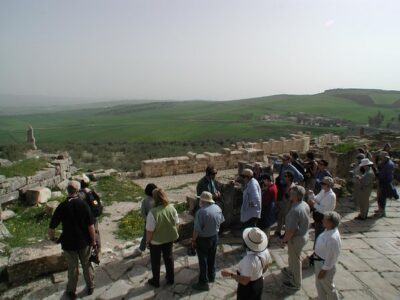
The private format is also useful if your interests are specific. You can ask more questions about ancient cultures, Tunisian life, or the countryside without trying to speak over a busload of strangers. Guides have been praised for answering questions and keeping their commentary from becoming a nonstop lecture.
Still, do not mistake private transport for a short outing. Dougga and Bulla Regia are in different parts of northwestern Tunisia, so the day involves a serious amount of driving. Bring water, wear practical shoes, and treat the road time as part of the price of reaching two less-central sites.
Dougga: Roman grandeur with Numidian roots
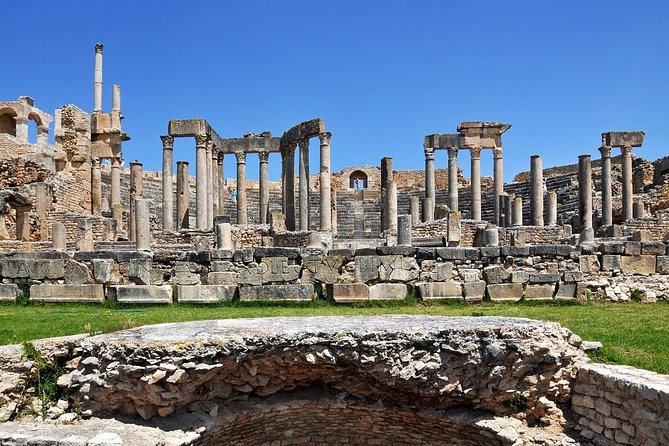
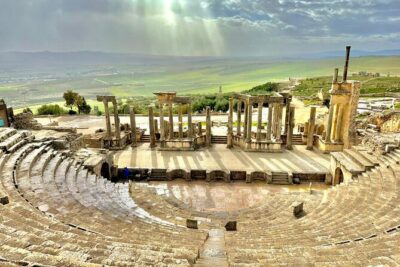
Dougga is the more dramatic setting of the two. The ancient city sits high above the surrounding hills, with stone columns and ruins spread across open ground.
The location gives Dougga much of its appeal. Instead of seeing fragments hemmed in by a modern city, you look out over green countryside and encounter the remains in a broad, quiet setting. The elevated position also helps you understand why this was a place of power long before the Romans arrived.
Your guide should help you read the site in layers. Dougga began as a Numidian center and later became one of the strongest expressions of Roman rule in Tunisia. The connection to Masinissa, its ruler during a period of prosperity, gives the ruins a political story as well as an architectural one.
I would give Dougga your full attention, even if you have visited other Roman sites around the Mediterranean. Its appeal is not just a famous monument or a single perfect column. It is the way the remains occupy the hill and show the scale of an ancient town.
The supplied timing lists only three minutes for Dougga, an obvious concern if interpreted literally. A visit of that length would barely allow you to step out of the vehicle. Since the excursion is built around two archaeological sites and the full day is scheduled for about eight hours, this appears to need clarification. Ask how long the guided walk lasts and which parts of Dougga are included.
Also expect uneven ground and open exposure. The information confirms that most people can participate, but it does not provide a detailed mobility assessment. If stairs, slopes, or rough surfaces are a concern, ask the operator before booking.
Bulla Regia and the Roman homes below street level
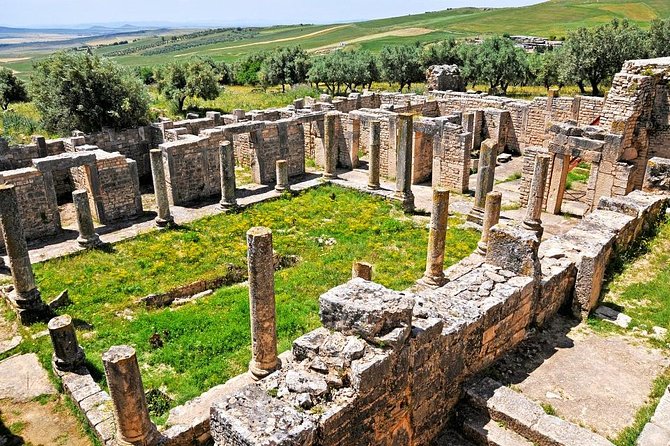
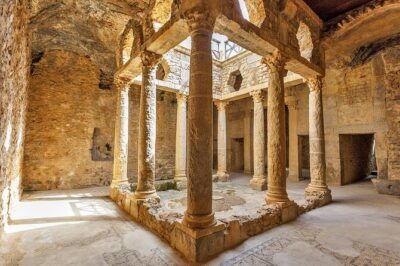
Bulla Regia is the day’s most unusual stop. This Roman city is known for houses with an underground floor, creating two-storey homes with one level below ground.
The design likely helped protect residents from summer heat and winter cold. For you, the practical result is a more physical visit than the usual Roman forum walk. You move from open ruins into rooms built below the surface, seeing how domestic architecture solved a climate problem.
Three hours are allotted to Bulla Regia, and that makes sense. The site is not something to rush through in a few photographs. The preserved villas are the main event, and their layouts give you a closer look at ordinary home life than a monumental temple usually can.
The experience has also been praised for allowing close access to the remains. That proximity is valuable because the underground rooms are best understood at human scale. You can see how the floors, walls, and spaces relate to one another rather than viewing everything from a distant path.
I would plan to spend your strongest concentration here. Dougga tells the story of a major city in a grand setting; Bulla Regia lets you picture people living, resting, and moving through their homes. If your interest is architecture, daily life, or Roman engineering, this may become the day’s highlight.
The same practical cautions apply: wear shoes with a firm grip and expect changes between open-air paths and lower rooms. The supplied details do not specify the exact condition of every surface or the number of stairs, so ask directly if you have mobility limits.
More things to do in Tunis:
- Private Tour to Kairouan, El Jem & Monastir from Tunis_hammamet
★ 5.0 · 301 reviews - Private tour: Medina,Carthage ,Sidi Bou Said, Bardo Museum+lunch
★ 5.0 · 230 reviews - Carthage, Bardo Museum, Sidi Bou Said and Medina Private Day Tour
★ 4.5 · 153 reviews - Guided Bike Tour of Carthage Archeological Site in Tunisia
★ 5.0 · 88 reviews
Testour offers a brief change of scene
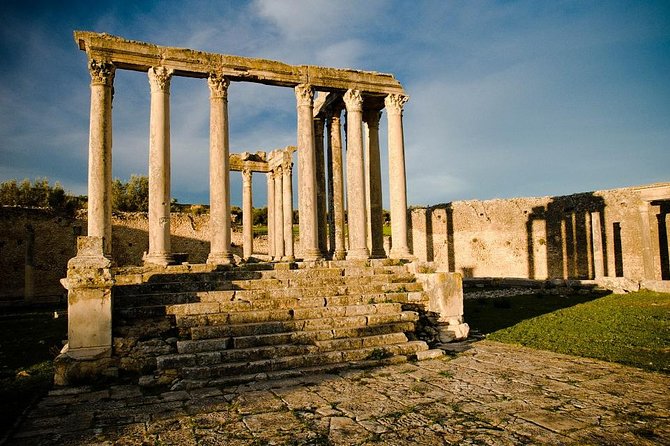
The drive includes a scenic pass through Testour, a town known for Andalusian architecture and its distinctive Great Mosque.
Only about ten minutes are assigned to this part of the route, and it is described as a pass through rather than a full walking tour. Set your expectations accordingly. You are getting a short visual introduction, not an extended exploration of the town.
That brief stop still adds useful context. The day is not only about Roman and Numidian remains. Testour brings a later cultural layer into view, with architecture shaped by Andalusian influence. It gives you something different to notice from the car window and helps break up the archaeological focus.
If Testour is especially important to you, ask whether the schedule permits a longer stop. The stated plan does not promise one.
Lunch is more than a box between ruins
Lunch is included when that option is selected, and the meal has earned some of the warmest practical praise. One account describes a local restaurant meal as better than expected for a tour, while another singles out a delicious vegetarian lunch arranged by the guide.
That is a good sign for a full-day outing. After walking through exposed archaeological sites, a proper meal is far better than relying on snacks in the vehicle. It also gives you a chance to eat something local rather than treating lunch as a forgettable interruption.
You need to advise the operator of dietary requirements when booking. A vegetarian option is available, but it should be requested in advance. The information does not specify the restaurant, menu, or drinks, so do not assume the meal will match a particular dietary plan unless you confirm it.
The strongest account here involved a guide taking the time to arrange the vegetarian meal. That suggests the tour team can be flexible, but advance notice remains the sensible move.
Guides, drivers, and the private-tour advantage
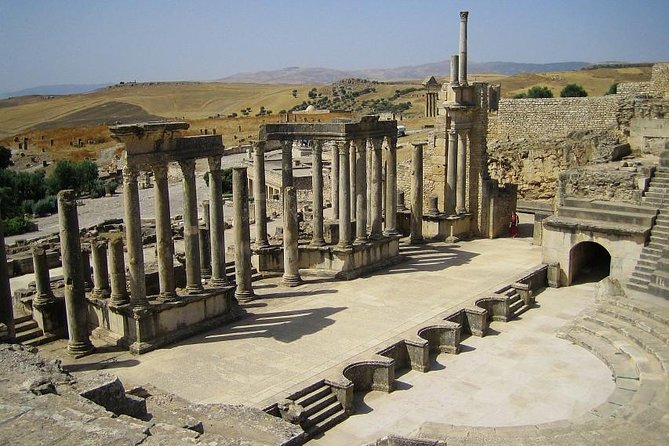
The guide can make or break an archaeological day. Broken columns and half-seen walls do not explain themselves, and the sites are far more rewarding when someone connects the stones to Numidian rule, Roman expansion, housing design, and Tunisian culture.
The guide names praised in the feedback include Mamdouh, Mahjoub, Mohammed, and Nejib. Nejib in particular was credited with strong knowledge of the ancient sites and a friendly manner, while other guides were appreciated for being informative, humorous, and careful not to talk continuously.
That range of praise points to a useful strength in the operation: the experience seems to depend on a real guide rather than an audio script. If the guide option is selected, a licensed guide is included. Confirm that choice when booking, since the inclusion list says the guide is provided if selected.
The driver also matters on this route. Idriss was singled out as helpful and kind, and several accounts describe clean, comfortable vehicles and professional driving. A private licensed driver is included, which removes the stress of navigating unfamiliar roads while keeping the group together.
There was one reported instance of a guide becoming unavailable and the agency arranging an alternative fairly quickly. The replacement was described positively. That does not guarantee a particular guide, but it suggests the company has some backup when plans change.
Is $115 good value for this day?
At $115 per person, the tour is not the cheapest way to see one ruin. But it combines two major archaeological sites, private round-trip transport, a driver, entrance fees when selected, and lunch when selected.
That bundle changes the calculation. Reaching Dougga and Bulla Regia independently would mean arranging transport across northern Tunisia, buying admissions, finding lunch, and managing the timing between sites. You would also lose the explanations that help turn scattered remains into a coherent story.
The value improves for a small group because the service is private and group discounts are available. A couple or family can share the vehicle and guide rather than joining a large coach. The price is less compelling if you only want a quick look at Dougga or if the package you choose excludes lunch, admissions, or guiding.
Read the inclusions carefully. The tour provides hotel pickup and drop-off from Tunis or Hammamet, but not from hotels in other cities. Entrance fees and lunch are marked as included if that option is selected, so confirm the exact package before booking.
I would view the $115 as a convenience and interpretation fee as much as a transport cost. You are paying to make a difficult day trip manageable and meaningful.
Who should book this excursion?
I would recommend it to you if you are staying in Tunis or Hammamet and want ancient sites beyond the capital. It suits people who enjoy history, architecture, Roman-era settlements, and long sightseeing days with a clear purpose.
It is also a good fit for first-time visitors who do not want to rent a car or piece together rural transport. The private setup gives you a more personal day, and the guides can answer questions about Tunisia beyond the ruins.
Families and older visitors should consider the walking surfaces and underground sections. Most people can participate, and service animals are allowed, but detailed accessibility information is not supplied. Ask about steps, slopes, and surface conditions if those points matter to you.
I would skip it if you have only one free day and prefer the relaxed pace of a single site. I would also hesitate if you dislike early departures or long drives. This is a full historical outing, not a gentle half-day excursion.
Booking details worth checking first
Confirmation is received at booking, and free cancellation is available up to 24 hours before the local start time. Cancellations or changes made less than 24 hours before the start are not accepted for a refund.
Before finalizing, confirm four practical points:
- Your exact pickup address in Tunis or Hammamet
- Whether lunch is included in your chosen option
- Whether entrance fees are included
- Whether a licensed guide is included
Also ask about the Dougga schedule. The three-minute figure needs explanation, and you deserve to know how the eight-hour day is divided.
Should you book Dougga and Bulla Regia?
Yes, if you want two of northern Tunisia’s most distinctive ancient sites without handling the transport yourself. The combination is strong: Dougga gives you a sweeping hilltop city with Numidian roots, while Bulla Regia offers rare underground Roman homes that make the past feel unusually close.
The best reasons to book are the private vehicle, the praised guides, the comfortable pace at Bulla Regia, and the lunch arrangements, including vegetarian food when requested. The main caution is the long day and the unclear Dougga timing.
Ask the operator to confirm the schedule and inclusions, then book with sensible shoes, water, and an appetite for ruins. For history-minded visitors based in Tunis or Hammamet, this is a well-priced way to reach places that are awkward to visit alone.
FAQ
How long does the tour last?
The tour lasts approximately eight hours. One reported schedule left Tunis at about 7 a.m. and returned around 3 p.m.
Where is hotel pickup available?
Pickup and drop-off are offered from hotels or accommodations in Tunis or Hammamet. Pickup from hotels in other cities is not included.
Are Dougga and Bulla Regia included?
Both sites are part of the planned route. Entrance fees are included if that option is selected when booking.
How much time is spent at Bulla Regia?
The planned visit to Bulla Regia lasts about three hours.
How long is the Testour stop?
The scenic pass through Testour is listed at about ten minutes. It highlights Andalusian architecture and the Great Mosque.
Is lunch included?
Lunch is included if that option is selected. You should advise the operator of dietary requirements when booking.
Is a vegetarian meal available?
Yes. A vegetarian option is available, but you should request it in advance.
Is the tour private?
Yes. Only your group participates in the private activity.
Can I cancel for a full refund?
Yes, if you cancel at least 24 hours before the experience start time. Cancellations or changes made less than 24 hours before the start are not accepted for a refund.
Just added in Tunis
- Private Arrival Transfer: Tunis Airport to Tunis Hotel★ 4.5 · 5 reviews
- Cap Bon Guided Day Tour from Tunis★ 5.0 · 2 reviews
- Dougga Guided Day Tour from Tunis★ 5.0 · 5 reviews
- Unveiling the Beauty of Sidi Bou Said and Carthage Private Tour★ 5.0 · 2 reviews
- Tunis Carthage Private Arrival Airport Transfer to Tunis★ 5.0 · 4 reviews
- Tunis Group Tour: Carthage, Sidi Bou Said, Bardo museum & Medina★ 5.0 · 5 reviews
- Bardo Museum , Oudhna and the roman aqueduct★ 5.0 · 4 reviews
- Bardo Museum- The ruins of Carthage- Village of Sidi Bou Said★ 5.0 · 4 reviews
Dougga and Bulla Regia, compared.
Private Excursion to Testour, Dougga and Bulla Regia from Tunis.
Read our review →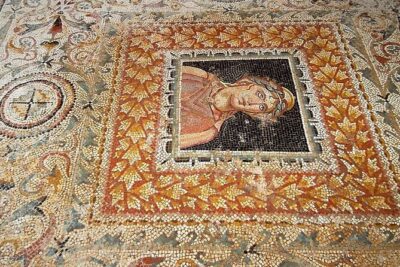
Private Day Trip to Testour, Dougga and Bulla Regia from Hammamet
Read our review →
Private Guided Tour of Dougga and Testour Mosque
Read our review →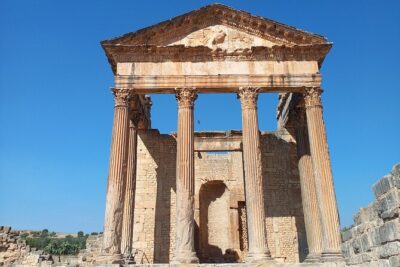
Bulla Regia and Beni Mtir Cascade Daytrip from Tunis
Read our review →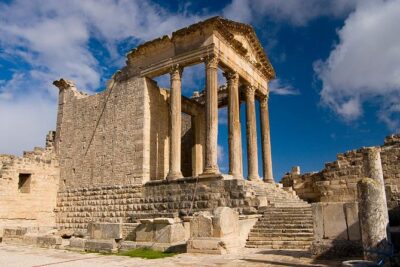
DAY TRIP TO Dougga & Bulla Regia , DEPARTURE FROM Tunis
Read our review →Browse the lists this tour appears in