
Reviewed · DOUGGA AND BULLA REGIA
Private Day Trip to Testour, Dougga and Bulla Regia from Hammamet
Ancient Tunisia rewards the curious. This private day trip links Andalusian Testour with two major Roman sites, giving you excellent variety in one long outing. I like the personal service, the included admissions, and the chance to see places that a typical beach stay in Hammamet leaves out. The main caution is the distance: the day can run well beyond the advertised eight hours.
I also like that the route is more than a ruins checklist. Testour adds living Tunisian culture, Dougga supplies the grand Roman monuments, and Bulla Regia reveals a different side of Roman life below ground. Guides such as Faouzi, Mohamed, and Chaoukni have been praised for clear explanations and careful help, though driving conditions and the long road can make this a tiring day.
In This Review
- Five reasons this private trip earns attention
- Why this route is worth the long road from Hammamet
- Testour and the Great Mosque’s unusual clock
- Two hours at Dougga, Tunisia’s great Roman site
- Bulla Regia and the logic of underground living
- What the private format really adds
- Price, time, and the value of the day
- What to bring for three archaeological stops
- Who should book this trip
- FAQ
- What time does the tour start?
- How long does the tour last?
- Is hotel pickup offered?
- Is this a private tour?
- Are admission tickets included?
- Can most people take part?
- What happens if the weather is poor?
Five reasons this private trip earns attention
- Testour’s counterclockwise clock tower: The 23-meter octagonal minaret of the Great Mosque has a clock whose hands turn in the opposite direction from what you expect.
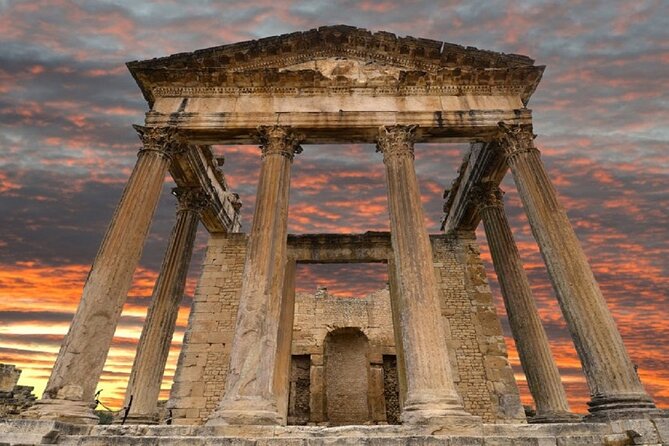
- Dougga’s unusually complete Roman center: You can see the Capitol, theater, forum, baths, triumphal arch, houses, and Libyco-Punic Mausoleum in one expansive archaeological site.
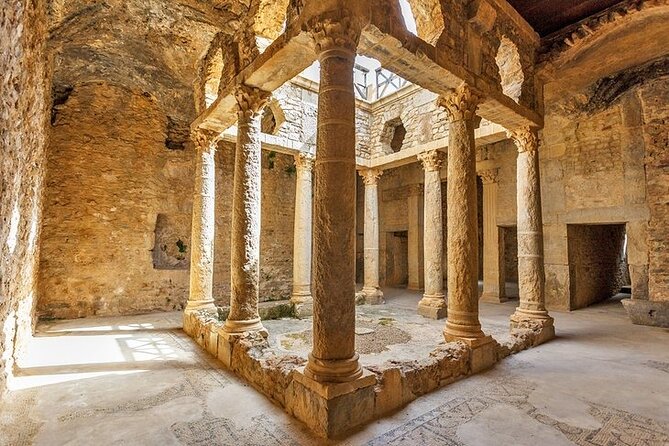
- Bulla Regia’s underground homes: The site is known for buildings placed below ground, a striking answer to the heat and a useful contrast with Dougga’s monumental ruins.
- A private vehicle and guide: Only your own group takes part, so the pace and explanations can be more personal than on a large coach outing.
- Local food moments: The route may include regional cheese, pomegranate juice, or even bread baked by a Berber woman in an old furnace, depending on the day and conditions.
Why this route is worth the long road from Hammamet
Hammamet is an easy base for beaches, resorts, and day trips along Tunisia’s northeastern coast. This excursion heads west into a less familiar part of the country, toward the fertile northwest and the important ancient settlements around Dougga and Jendouba.
The appeal is the sequence. You do not spend the whole day looking at similar columns. Testour offers an Andalusian Muslim town founded by Moorish people in the early 17th century. Dougga shows an indigenous settlement that grew into one of North Africa’s finest Roman cities. Bulla Regia adds Numidian, Roman, and Christian layers, along with its unusual subterranean architecture.
That range gives the day a clear story. You see how different communities shaped the same part of Tunisia over many centuries. I find that far more satisfying than visiting a single famous ruin, taking a few photographs, and heading straight back to the coast.
The advertised duration is about eight hours, with a 7:30 a.m. start. Plan with flexibility, though. One account describes an 11.5-hour day, so the actual length can depend on road conditions, time at the sites, stops, and the pace of your group. If you have evening plans in Hammamet, leave plenty of space.
More Roman sites at Dougga and Bulla Regia:
Testour and the Great Mosque’s unusual clock
Testour is a small Andalusian village founded by people who arrived from Iberia in the early 17th century. The town’s identity reflects that migration, and its Great Mosque offers the clearest visual clue.
The minaret rises 23 meters and has an octagonal form. Small double windows open the facade, with glazed inscriptions and architectural details that recall southern Spain. Its shape has been compared with the bell towers of Aragon, which makes it feel different from the square minarets you may see elsewhere in Tunisia.
The clock is the detail you will remember. Its hands move counterclockwise, a curious feature that gives the building an extra spark. The stop is described as a panoramic tour rather than an extended walking visit, so expect an introduction to the town and its main landmark rather than a full morning of local exploration.
That short visit works well in the larger plan. Testour breaks up the drive and gives you a cultural setting before the ancient sites begin. It also helps you see Tunisia as more than a Roman story.
Food may be part of the stop. A regional cheese tasting is included in the description, and one day included pomegranate juice. These details can change with the route and timing, but they are exactly the kind of small local touch that makes a long excursion feel less mechanical.
A further stop on the road included bread baked by a Berber woman in an old furnace, followed by a chance to eat it. This is not presented as a guaranteed part of every departure, so treat it as a possible bonus, not a promise. Still, it shows the kind of unscripted local moment that can make the drive memorable.
Two hours at Dougga, Tunisia’s great Roman site
Dougga is the centerpiece of the day. UNESCO placed it on the World Heritage List in 1997 and described it as the best-preserved small Roman city in North Africa. Even that formal praise understates the value of seeing so many parts of an ancient town together.
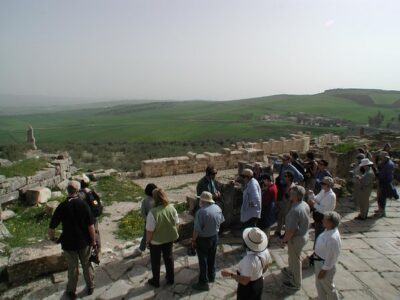
You receive about two hours at the site, with admission included. That sounds generous, but Dougga covers a large area and the remains are spread across open ground. Wear firm shoes, bring water, and expect uneven walking. The site is not a quick roadside monument.
Start with the monumental center. The Capitol is the visual anchor, with its tall columns and strong position above the ancient town. Nearby, you can examine the forum, market, and the Place of the Winds, where the layout helps explain how public life was organized.
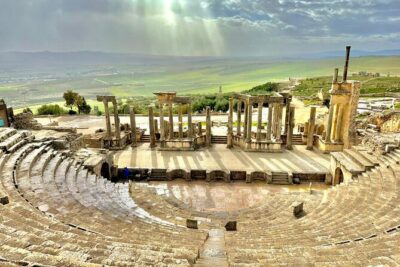
The theater is another highlight. Its well-preserved form makes it easier to imagine performances and public gatherings than at many ancient sites. One account singled out the Roman theater and the Temple of Venus as especially memorable, and both deserve time rather than a rushed photograph.
The thermal baths show a more practical side of city life. Roman towns were not only about temples and official buildings. Bath complexes, houses, markets, entertainment spaces, and roads reveal how people spent ordinary days.
Look also for the triumphal arch and the Libyco-Punic Mausoleum. These remind you that Dougga was not simply a Roman town dropped onto empty ground. It began as an indigenous settlement, and its monuments reflect several periods and traditions.
That layered story is one of Dougga’s greatest strengths. You can see how a local foundation developed during the Roman period, while older North African forms remained part of the town’s identity. A good guide turns scattered stones into a readable place, and this is where the guide matters most.
Faouzi has been praised for taking groups through the key areas with careful explanations. Mohamed has been described as friendly and well informed, while Chaoukni has been praised for combining site commentary with information about local plants and the countryside along the way. You are not guaranteed a particular guide, but these reports suggest that the guiding is a major part of the experience rather than an afterthought.
Two hours may feel tight if you want every inscription and side building. If you are deeply focused on archaeology, you may leave wishing for more time. For a private day linking three destinations, though, the schedule gives you a solid first look without turning Dougga into the only stop.
Bulla Regia and the logic of underground living
Bulla Regia lies near Jendouba in northwestern Tunisia. Its story reaches back at least to the late sixth century BC, when the settlement was founded by the Numidians. It later became a royal residence, an autonomous community in the early Roman period, a municipality under the Flavian emperors, and a Roman colony under Hadrian.
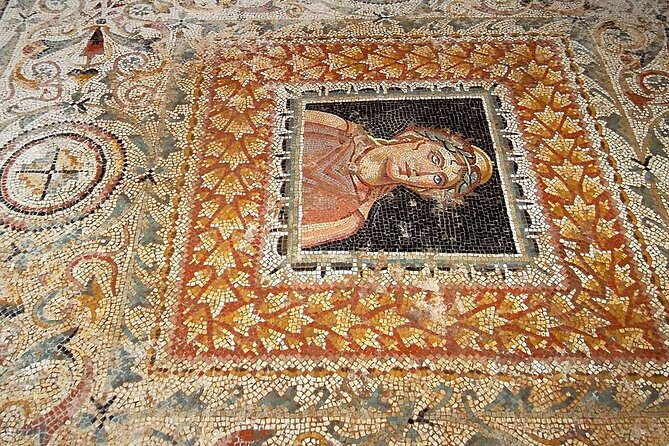
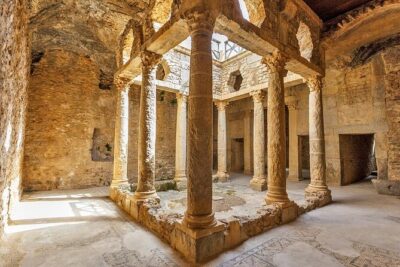
That sequence gives the site considerable historical weight, but the architecture is what makes it special. Bulla Regia is famous for houses and buildings placed below ground. The design helped protect residents from the heat and created interior spaces that could be decorated and used in a very different way from the open public monuments at Dougga.
The site is also known for religious buildings. You can see the Capitol, Temple of Apollo, two Christian basilicas, and the Church of Alexander. These remains show how the town changed as religious life shifted from older Roman worship to Christianity.
The visit is allocated about two hours, with admission included. Bulla Regia is less about one giant postcard view and more about moving through a set of spaces that reward close attention. A guide can explain why the underground plan mattered and help you distinguish a temple, basilica, civic structure, and private residence.
The contrast with Dougga is important. At Dougga, the Capitol, theater, arch, and forum give you a strong sense of public Roman power. At Bulla Regia, the lower-level homes and religious buildings bring you closer to domestic life and changing belief. Seeing both sites on the same day makes each one easier to understand.
If you are short on energy by this point, Bulla Regia may require discipline. The route is long, and two major archaeological sites in one day can blur together if you rush. I would pay attention to the underground rooms first, then use the guide’s explanations to connect the religious buildings to the town’s later periods.
More things to do in Hammamet:
- Private tour: Medina,Carthage ,Sidi Bou Said, Bardo Museum+lunch
★ 5.0 · 194 reviews - Quad ride on the hills of Hammamet
★ 4.0 · 104 reviews - 2-Day Tunisian Sahara Tour with Food & Stay from Hammamet
★ 4.5 · 80 reviews - Tour to the Medina of Hammamet and the Spice Market of Nabeul
★ 4.0 · 45 reviews
What the private format really adds
The tour is private, so only your own group participates. That matters most at Dougga and Bulla Regia, where you may want to pause at a monument, ask about a confusing structure, or move on when your feet have had enough.
A private tour does not automatically mean a leisurely day. The route covers a lot of ground, and the fixed start time of 7:30 a.m. is necessary if you are to fit in all three stops. The advantage is control within that schedule, not freedom to wander indefinitely.
The guides are another strong point. French-language guiding has been praised, and the available accounts also describe guides who explain the ancient sites clearly and help with walking difficulties. One guide adjusted the order of the visit when rain threatened, making sure the main areas were covered before the weather worsened.
That kind of judgment is useful. Archaeological sites are exposed, and weather can change the comfort and safety of the visit. The experience requires good weather, and poor conditions can lead to a different date or a full refund.
Transport is included through hotel pickup, though the exact pickup area is not specified in the details provided. Confirm your pickup point when booking. The tour is also near public transportation, service animals are allowed, and most people can participate. If someone in your party has walking limitations, mention it before departure, since both sites involve outdoor archaeological ground.
One safety point deserves a plain mention. An account describes the driver hitting the back of another car during the day. No one was seriously injured, but the collision caused delays. This appears to be an isolated incident, not a normal feature of the tour, yet it is fair to remember that a long road day depends partly on traffic and driving conditions.
Price, time, and the value of the day
At $133.57 per person, this is not the cheapest way to see Tunisia’s ancient sites. It can still be good value if you are traveling as a small private group and want hotel pickup, a dedicated vehicle, a guide, and admission to Dougga and Bulla Regia included.
The price makes more sense when you consider the distances. Reaching both archaeological sites independently would require arranging transport, working out the route, buying admissions, and finding a way to understand what you are seeing once there. A private guide also saves you from treating Dougga as a collection of impressive but disconnected ruins.
The calculation changes for a solo visitor or a couple. A private tour costs more per person than a large group departure, but you receive flexibility and personal attention. For families or several friends sharing the vehicle, the price may feel more reasonable.
Book well ahead if your dates are fixed. The trip is booked an average of 33 days in advance, which suggests that demand is steady even though the tour has only a small number of recorded ratings. Free cancellation is available up to 24 hours before the 7:30 a.m. start, with a full refund. Changes made inside that 24-hour window are not accepted, and poor weather can lead to a new date or full refund.
What to bring for three archaeological stops
Keep your packing simple, but prepare for a full day outside.
- Wear comfortable shoes with good grip. Dougga and Bulla Regia both involve uneven archaeological ground.
- Carry water and sun protection. The sites are open and the visit can last several hours.
- Bring a light layer for the early start and changing weather.
- Leave room in your schedule for a late return. The official estimate is eight hours, but one day lasted 11.5 hours.
- If walking is difficult for someone in your group, tell the provider in advance.
- Bring a phone or camera for Testour’s minaret, Dougga’s theater and Capitol, and Bulla Regia’s underground structures.
The best approach is to treat this as a serious archaeology day, not a relaxed resort excursion. You will spend a lot of time in a vehicle, but the reward is access to three places with very different identities.
Who should book this trip
I would recommend it most strongly to people who already care about ancient architecture, Roman civilization, North African history, or the meeting of different cultures. Dougga alone is a strong reason to go, and Bulla Regia gives the day a second major archaeological payoff.
It also suits you if you prefer a private guide to a large group and value explanations over simply collecting photographs. The high rating and full recommendation record support the view that the guiding, transport, and overall planning work well for most participants.
I would hesitate if you dislike long drives, have only a short stay in Hammamet, or want a slow day with plenty of time for cafés and shopping. The 7:30 a.m. departure is early, and the real duration may be much longer than eight hours.
For the best fit, choose this trip when you want one concentrated day of ancient Tunisia and you are willing to trade some comfort and free time for access to Dougga and Bulla Regia. If that sounds like your kind of day, the private format and strong site coverage make the $133.57 price defensible.
FAQ
What time does the tour start?
The stated start time is 7:30 a.m.
How long does the tour last?
The listed duration is approximately eight hours. One account describes an 11.5-hour day, so you should allow extra time for the route, stops, traffic, and site visits.
Is hotel pickup offered?
Yes, pickup is offered. The exact pickup details should be confirmed when you book.
Is this a private tour?
Yes. Only your own group participates in the activity.
Are admission tickets included?
Admission is included for the Dougga and Bulla Regia visits.
Can most people take part?
The tour states that most people can participate. Service animals are allowed, and the experience is near public transportation. Because the archaeological sites involve walking on uneven ground, mention any walking concerns before booking.
What happens if the weather is poor?
The experience requires good weather. If it is canceled because of poor weather, you can receive a different date or a full refund. You can also cancel for a full refund up to 24 hours before the start time.
Just added in Hammamet
- Transfer from Airport Tunis Carthage To Hammamet★ 5.0 · 2 reviews
- From Hammamet: Sahara Desert Overnight Camping★ 4.5 · 2 reviews
- Private Guided Tour of Zaghouan, Thuburbo Majus and Dougga from Hammamet★ 5.0 · 1 review
- Private Transfer from Tunis Carthage Airport to Hammamet★ 5.0 · 2 reviews
- Executive: Transfer Tunis Airport to Hammamet by Mercedes E Class★ 5.0 · 4 reviews
- Private Excursion of Friguia Park and Medina of Hammamet★ 4.5 · 4 reviews
- Day Trip to Cap Bon★ 5.0 · 2 reviews
- Zaghouan, Thuburbo Majus and Dougga Private Self-Guided Excursion from Hammamet★ 5.0 · 2 reviews
Dougga and Bulla Regia, compared.
Private Excursion to Testour, Dougga and Bulla Regia from Tunis.
Read our review →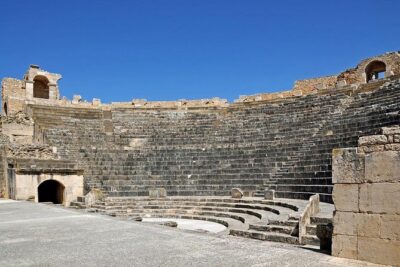
Full Day Dougga & Bulla Regia Via Testour Private tour with Lunch
Read our review →
Private Guided Tour of Dougga and Testour Mosque
Read our review →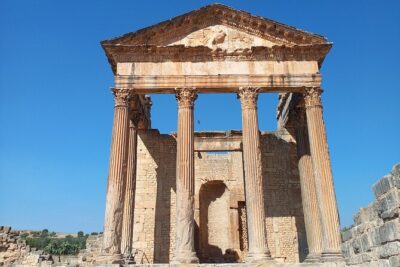
Bulla Regia and Beni Mtir Cascade Daytrip from Tunis
Read our review →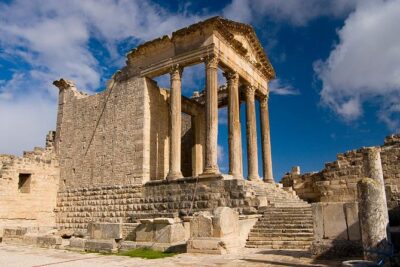
DAY TRIP TO Dougga & Bulla Regia , DEPARTURE FROM Tunis
Read our review →Browse the lists this tour appears in